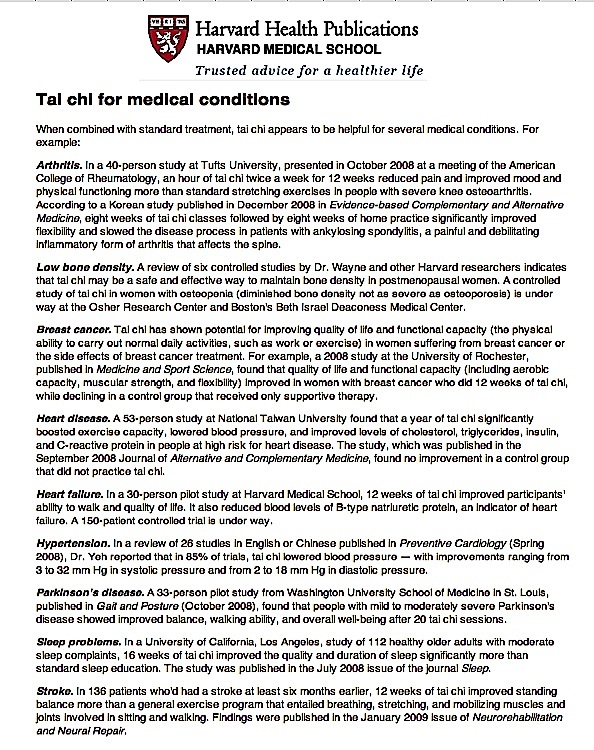
Here are some of the articles that have appeared in research and health
publications since about 1990.
Studies by the National Institute on Aging (NIA), launched in1990:
Two studies, one by Steven L Wolf, PhD, and the other by Leslie Wolfson, MD, and collegues, found that Tai Chi was effective
in improving balance and strength among older people. Older people taking part in a 15 week Tai Chi program reduced their
risk of falling by 47.5%.
Circulation, vol 90, 2877-2885, 1994. J.S. Wang,
et al. Strenuous exercise may sensitize platelet adhesiveness and aggregability in both healthy patients and those
with stable angina. Moderate exercise, in contrast, supresses significantly those platelet functions and pay protect from
the risk of cardiovascular diseases.
The Harvard Health Letter (21:11, 1996) reports a study in the May 1996 Journal of the American
Geriatrics Society, showing that the slow and precise movements of Tai Chi Chuan improved the balance of seniors.
The University of California, Berkeley, Wellness Letter, 1998, cites the benefits of the "smooth, balanced,
and low-impact" exercise to health.
The CIGNA newsletter, Wellbeing, winter, 1998, advises that Tai Chi Chuan has been
shown to increase immunity, reduce stress, alleviate gastric problems, hypertension, and other ailments.
The Harvard Woman's Health Watch, Dec 2000, article, "Tai Chi: Meditative movement for Health" cites
the benefits for women, and lists Master William C.C. Chen's video's as a selected Woman's Health Watch
resource.
The Annals of Behavioral Medicine, 2001; 23:139-146, documents improvements over a 6 month period in
physical functions in daily and more strenuous activities.
Br. J. Sports Med 2001; 35:148-156
Li, Hong, and Chan
Tcc is a moderate intensity exercise that is beneficial to cardiorespiratory function, immune capacity, mental control,
flexibility, and balance control.
Journ. Altern. Complement. Med. 2003, Oct, 9,(5):747-754
Tsai JC, Wang WH, Chan P, et al.
The Beneficial Effects of Tai Chi Chuan on Blood Pressure and Lipid Profile and Anxiety Status in a Randomized
Controlled Trial
found were a decrease of 15.6 mm Hg Systolic and 8.8 Diastolic pressure, decrease of total serum cholesterol
of 15.2 mg/dL, with increased HDL and decreased LDL, as well as decreased measures of anxiety.
The Archives of Internal Medicine, Mar 8 2004, report many benefits to heart, circular system, and joint
problems, as well as other chronic health conditions. The study was done by
Wang Chenchen, MD, at Tufts-New England Medical Center, Boston, Mass.
AARP Bulletin for May, 2004 recommends the benefits of Tai Chi Chuan for its readers.
International Journal of Diabetes in Developing Countries, vol 25:105-109,
2005. V. Ambarish, et al. After 1 month of regular moderate exercise Tumor Necrosis Factor Alpha shows a fall below
baseline levels; not so with regular strenuous exercise. Regular moderate exercise has a beneficial effect on helath by
way of keeping this cytokine at low levels.
BRITISH JOURNAL OF SPORTS MEDICINE, 2006;
40 239-243. S-H YEH, et al. Regular tai chi chuan exercise over 12 weeks increased functional mobility of middle aged participants,
and increased the ratio of T helper cells to supressor cells, while increasing growth factor beta and interleuckin 10 under
antigen stimulation.
Japanese Journal of Physical Fitness and Sports Medicine
55: 99-102 2006 Kawano Ichiro et al.
"Electromyographic
(EMG) Analysis of Tai Chi"
EMG characteristics of various leg muscles were compared from Tai Chi Chuan to
bicycling and jogging, and found to exceed muscle activities in the other exercises. Tai Chi Chuan could be a useful strength
building exercise.
DIABETES CARE 30:716-718 2007. S-H YEH, et al. Regular Tai Chi Chuan exercise can imrove glucose metabolism,
and benefit immune regulatory function in type 2 diabetic patients.
NATIONAL INSTITUTES OF HEALTH study reported in the New york Times,
April 17, 2007, shows that tai chi practice improves immunity to the shingles virus; also, practitioners had better response
to the vaccine.
A STUDY AT UCLA Oct 22, 2007, shows tai chi practice reduces headache pain, and improves perceived energy, emotional
well-being, and social functioning.
JOURNAL OF NEUROSCIENCE, 2007(31):8324-8333 The Neurochemically Diverse Intermedius Nucleus of the Medulla as a Source of Excitory and Inhibitory Synaptic Output
to the Nucleus Tractis Solitarius. I.J. Edwards, et. al. Pathways have been found showing that neck flexion and
tension can increase respiration, heart rate, and blood pressure. This occurs in the connection between the spinal cord ant
the nucleus tractus solitarius of the brain stem.
A study published in INTERNAL MEDICINE, and summarized at www.internalmedicinenews.com, Feb 2, 2008, was conducted
by Dr Ruth Taylor-Piliae. In addition to improvement in balance, this is the first study to document improvement in cognitive
function in comparison to the control group performing western-style exercise.
British Medical Journal Apr 2, 2008- Tai Chi exercisees imporves
type 2 diabetes control and T cell helper function; a benefit of regular moderate exercise over strenuous exercise. See
Sciencedaily.com/releases/2008/03/080331220843.htm
Recent articles have appeared demonstrating the benefits of tai chi chuan for arthritis. Here are some links to some
sites: (just click on the link)
This article reviews several clinical studies that demonstrate benefits in improved range of motion, cardiovascular wellness,
oxygen uptake and motor control.